

Most people assume shipping live fish food is as straightforward as mailing a package. It isn't. Understanding how live fish food delivery logistics works reveals a highly coordinated process involving precise timing, specialized packaging, regulatory compliance, and cold-chain technology. Whether you're managing an aquaculture facility or maintaining a high-end aquarium, knowing how this supply chain operates helps you make smarter sourcing decisions and significantly reduces the risk of receiving a dead-on-arrival shipment.
Table of Contents
- Key takeaways
- How live fish food delivery logistics works: the full picture
- Packaging methods that keep live food alive
- Scheduling, cutoffs, and carrier coordination
- Regulatory requirements for cross-border shipments
- Technology and logistics innovations reducing transit risk
- What I've learned that most suppliers won't tell you
- Why Demeterbioscience supports smarter live food delivery
- FAQ
Key takeaways
| Point | Details |
|---|---|
| Timing is everything | Suppliers ship Tuesday through Friday to avoid weekend transit failures that kill live product. |
| Packaging preserves survival | Oxygenated double bags with insulated boxes and gel packs maintain water quality and temperature across 24-hour windows. |
| Regulations add lead time | Cross-border shipments require veterinary health certificates and at least 5 business days' advance notice to authorities. |
| Technology reduces spoilage | Regional logistics centers, IoT temperature sensors, and AI routing cut delivery delays and product loss. |
| Customers complete the chain | Prompt package opening and immediate acclimation are not optional steps. They determine whether your live food survives. |
How live fish food delivery logistics works: the full picture
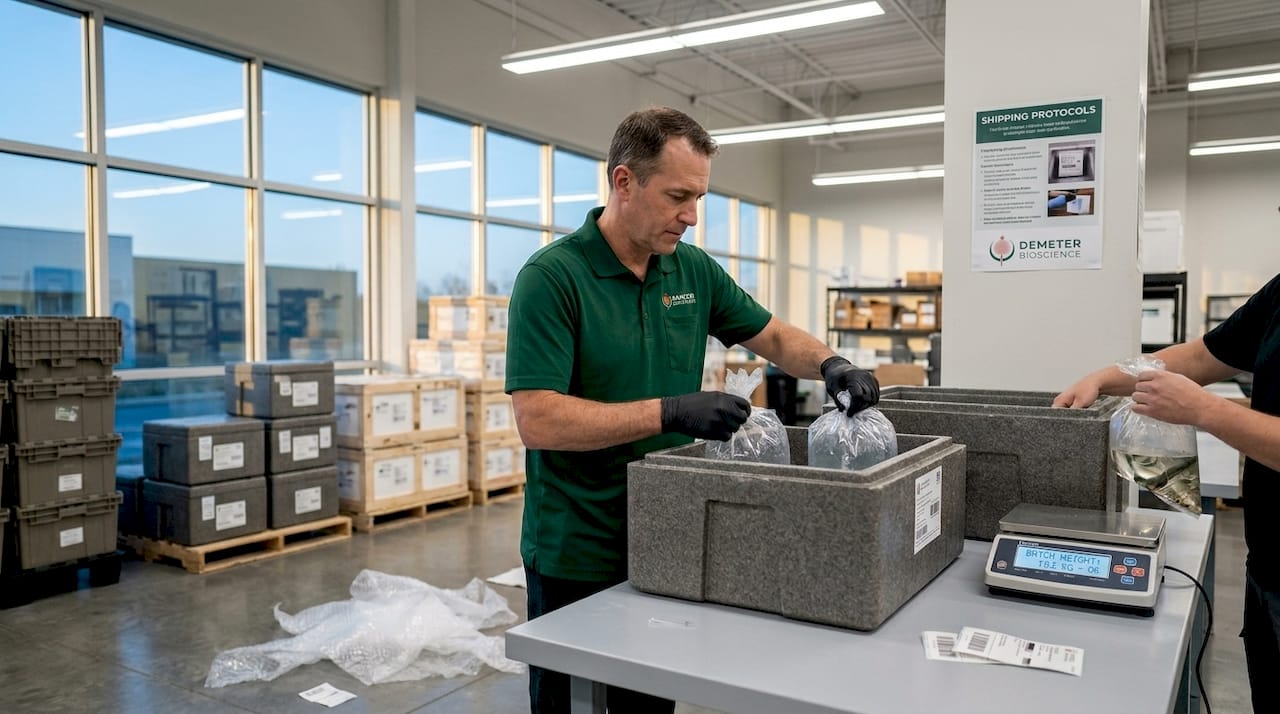
Live fish food is not like shipping a book or a pair of shoes. You're dealing with organisms that consume oxygen, produce ammonia, and respond to temperature swings within minutes. The entire fish food delivery process is built around one core constraint: the clock starts the moment a shipment leaves the facility.
Reputable U.S. suppliers follow a tight shipping window: Tuesday through Friday, with orders typically packed and handed off to carriers during the late afternoon. That timing is not arbitrary. It aligns live shipments with overnight carrier sorting schedules so that the product moves without sitting in a warehouse over a weekend.
The fish supply chain logistics model used by established suppliers relies heavily on overnight or next-day air services through carriers like FedEx and UPS. Anything slower introduces too many variables. A 48-hour ground transit at variable temperatures is essentially a death sentence for most live aquatic feeders.
Packaging methods that keep live food alive
Packaging is where most of the real science happens. The goal is simple: replicate viable water conditions for 24 to 48 hours inside a sealed box. Getting there requires several stacked interventions working together.
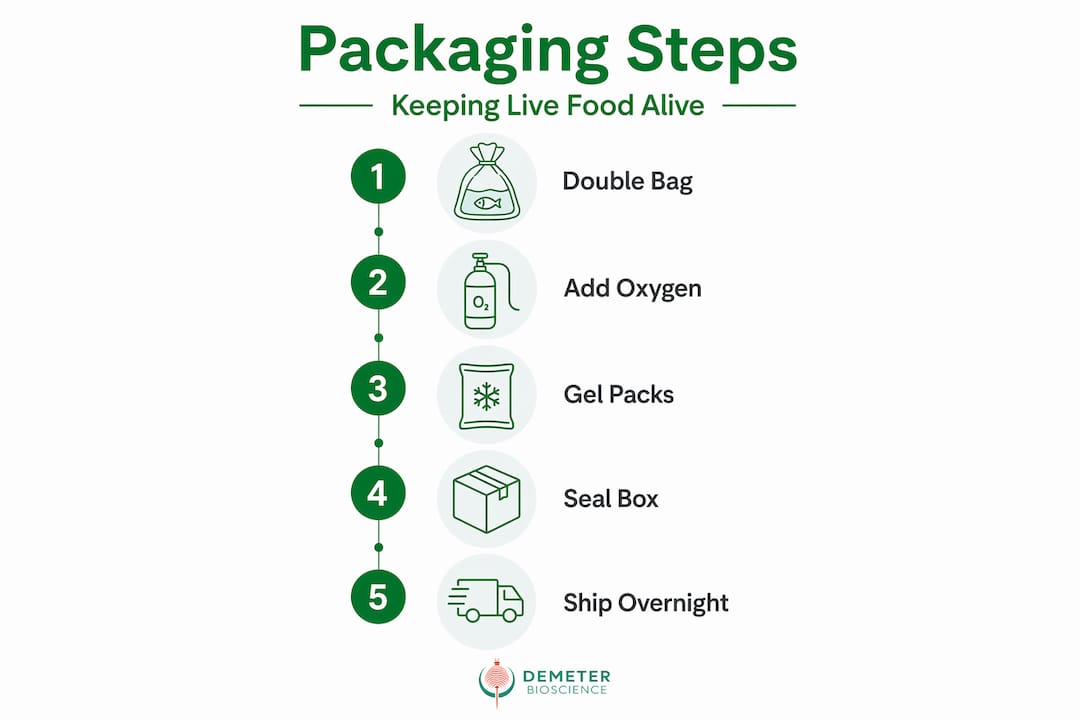
The most widely used method involves double-bagging the live organisms with a ratio of roughly one-third water to two-thirds pure oxygen. The sealed inner bag traps the oxygen supply, while the outer bag provides a buffer against punctures. Insulated shipping boxes with temperature-stabilizing media like phase-change gel packs handle the thermal side. Unlike standard ice packs, phase-change materials absorb heat without introducing rapid temperature drops that stress aquatic organisms.
A newer and increasingly preferred option is the breather bag. Breather bags use oxygen-permeable materials that allow continuous oxygen diffusion across the bag wall, eliminating the need to pump pure oxygen inside. This changes the ammonia and gas dynamics inside the bag, allowing for longer safe transit times when paired with proper insulation. They represent a meaningful shift in live fish food transport capability.
Seasonal variables also drive packaging decisions. A shipment moving in January through the Midwest requires heavier insulation and heated gel packs, while a July shipment to Florida may need additional cooling media. Competent suppliers adjust their packaging protocols based on both origin and destination weather conditions at the time of the order.
- Pre-shipping fasting: Suppliers withhold food from live feeders for 24 to 48 hours before packing. This reduces gut content, cuts ammonia production during transit, and improves survival rates.
- Oxygen-to-water ratios: The standard approximately two-thirds oxygen to one-third water ratio maximizes dissolved oxygen availability during the shipment window.
- Insulated boxes: Polystyrene-lined boxes slow heat transfer; gel pack configuration is adjusted based on season and transit duration.
- Breather bag applications: Best suited for longer or multi-day transits where sealed bag oxygen depletion becomes a limiting factor.
- Weather-sensitive protocols: Cold-chain materials covering 24 to 48 hour windows are the minimum standard for reliable live aquatic food delivery.
Pro Tip: If you're sourcing live fish food for a large aquaculture facility, ask your supplier explicitly whether their packaging protocol changes by season. A supplier using the same packaging in January and July is cutting corners.
Scheduling, cutoffs, and carrier coordination
The operational schedule behind live fish food shipping is more precise than most customers realize. Miss the carrier cutoff by an hour, and your shipment sits in a facility overnight before it even begins its journey. That lost time translates directly to reduced oxygen, increased ammonia, and higher mortality.
Here is how the scheduling process typically works from order to delivery:
- Order cutoff: Most suppliers require orders by 10 AM local time to qualify for same-day processing and shipment.
- Packing window: Live food is packed during mid to late afternoon, timed to coincide with afternoon carrier pickups rather than morning ones.
- Carrier handoff: Packages are physically transferred to FedEx or UPS routes that feed into overnight sorting facilities, targeting next-morning delivery.
- Transit tracking: Customers receive tracking notifications and are expected to monitor delivery windows in real time.
- Receiving protocol: Upon delivery, customers must open packages immediately and begin acclimation. Leaving a live shipment on a doorstep for several hours negates every investment made upstream.
The customer responsibility for prompt opening and acclimation is also tied directly to warranty and DOA policies. Most suppliers require photo evidence of dead-on-arrival product submitted within two hours of delivery. Miss that window, and you lose your claim, regardless of what went wrong.
Pro Tip: Schedule live food deliveries on days when you or a staff member can physically be present at the delivery address. Leaving a live shipment unattended for more than 30 minutes in summer heat or winter cold will compromise the product, regardless of how well it was packed.
Weekends are deliberately avoided by nearly all serious suppliers. Saturday delivery introduces the risk of a package sitting in a carrier facility over Sunday with no temperature control or intervention possible. The extra day of transit time under unregulated conditions is simply too high a risk for live product.
Regulatory requirements for cross-border shipments
Domestic live fish food shipping operates under relatively light regulatory oversight compared to international transport. Cross-border shipments introduce an entirely different layer of complexity that requires planning weeks, not days, in advance.
Exporters shipping live fish or shellfish internationally must notify the Fish Health Inspectorate at least five working days before departure, providing full documentation on the species, destination, and transit method. This notification window alone can catch unprepared shippers off guard.
Beyond the notification requirement, here is what international live fish food transport documentation typically involves:
- Health certifications: An official veterinarian must inspect the consignment and sign off on a health certificate confirming the organisms are disease-free and fit for export.
- Official veterinary inspection: The inspection must occur close enough to the shipment date to remain valid, which requires tight coordination between the supplier, the vet, and the logistics schedule.
- IATA compliance: For air transport, live animal transport regulations govern container specifications, labeling, documentation, and handler responsibilities across shippers, freight forwarders, and airlines.
- Import permits: The destination country may require advance import permits, adding another layer of lead time.
- Species-specific restrictions: Some live aquatic organisms face trade restrictions under CITES or national wildlife regulations, requiring additional permits depending on the species being shipped.
The practical implication for aquaculture operations sourcing live feeders internationally is that lead times must account for regulatory processing, not just shipping duration. A two-day transit can require three weeks of preparation.
Technology and logistics innovations reducing transit risk
The gap between a supplier who loses 20% of shipments to mortality and one who loses 2% comes down almost entirely to how well they've implemented modern logistics tools. The technology side of efficient fish food distribution has advanced considerably in recent years.
| Technology | Function | Benefit |
|---|---|---|
| Phase-change gel packs | Absorbs heat at a stable melt temperature | Prevents thermal shock without over-cooling |
| Breather bags | Continuous oxygen diffusion through bag wall | Extends safe transit window beyond sealed bags |
| IoT temperature sensors | Real-time thermal monitoring during transit | Triggers intervention before mortality occurs |
| AI routing software | Optimizes delivery paths and timing | Reduces transit delays and fuel consumption |
| Regional logistics centers | Localized fulfillment hubs closer to customers | Cuts delivery time and reduces packaging stress |
Regional logistics centers reduce delivery time by 35%, improve freshness, and reduce spoilage-related returns. By positioning live product closer to end customers, suppliers shrink the transit window and reduce the environmental and biological stress on live organisms.
IoT sensors embedded in shipping containers allow real-time temperature monitoring throughout the journey. If a package enters a heat spike in a sorting facility, the alert allows the supplier or carrier to intervene before the product is compromised. Combined with AI forecasting for delivery precision, these tools are transforming what was once a largely reactive process into a proactive one.
Subscription delivery models add another layer of optimization. When customers commit to regular delivery cadences, suppliers can pre-schedule carrier bookings, pre-stage packaging materials, and align production cycles with shipping windows. The result is a more predictable, lower-risk operation than single one-off orders.
For aquaculture businesses managing live food for freshwater fish on a continuous basis, subscription logistics eliminate the last-minute scrambling that leads to compromised shipments.
What I've learned that most suppliers won't tell you
I've spent significant time studying and working within live aquatic food supply chains, and the pattern I keep seeing is this: the biggest failure point isn't packaging quality or carrier speed. It's the handoff gap between supplier and customer.
Suppliers invest heavily in cold-chain packaging, timed carrier handoffs, and oxygenated bags. Then a customer leaves the package on their porch for four hours because they weren't home. Or they open it the next morning because they assumed it was fine overnight. The product was viable when it arrived. It wasn't viable by the time anyone noticed it.
The uncomfortable truth is that delivery delays affecting live survival are often shared-fault situations. Suppliers mitigate their portion through meticulous preparation. Customers need to meet that effort on their end. That means tracking your shipment, being present at delivery, and having an acclimation protocol ready before the package arrives.
The technology side of things, specifically breather bags and IoT monitoring, genuinely excites me because it reduces the margin for error at the supplier level. But no technology compensates for a customer who treats live food delivery like a regular Amazon order.
My honest recommendation: choose suppliers who ship on a fixed weekly schedule, communicate their carrier cutoff times clearly, and tell you upfront what your responsibilities are upon delivery. That transparency signals a supplier who understands the full logistics chain, not just their own half of it.
— Demeter
Why Demeterbioscience supports smarter live food delivery
At Demeterbioscience, everything about how we produce and ship live brine shrimp is designed around the logistics realities this article covers. Our controlled, land-based cultivation produces premium live brine shrimp with at least 40% protein content, packed to survive the transit window without the nutritional degradation common in wild-harvested alternatives. We offer direct-to-consumer shipments, monthly subscription plans for aquaculture operations, and bulk packages for museums and local fish stores. If you want to discuss delivery scheduling, packaging options, or a supply arrangement that fits your facility's needs, reach out directly. We're built for the customers who take live food logistics seriously.
FAQ
How does live fish food stay alive during shipping?
Live fish food is packed in oxygenated bags with temperature-stabilizing gel packs inside insulated boxes, maintaining viable water conditions for 24 to 48 hours. Breather bags extend this window further by allowing continuous oxygen diffusion through the bag wall.
Why do suppliers only ship live fish food Tuesday through Friday?
Shipping only on weekdays with overnight delivery avoids weekend transit risks, where packages could sit unattended in carrier facilities for up to two days without temperature regulation or intervention.
What documents are needed for international live fish food shipments?
Cross-border shipments require advance notification to the Fish Health Inspectorate at least five working days before departure, official veterinary health certificates, and compliance with IATA live animal transport regulations for air freight.
How do regional logistics centers improve fish food delivery?
Regional distribution hubs position live product closer to end customers, reducing transit time by up to 35% and lowering spoilage risk by shortening the period live organisms spend in temperature-variable shipping conditions.
What should I do when live fish food arrives?
Open the package immediately upon delivery, begin acclimation right away, and report any dead-on-arrival product with photo evidence within two hours. Most supplier DOA warranty policies are void after that window closes.